National Public Radio CEO Katherine Maher defended her network against longstanding allegations of political bias during an appearance on CNN News Central Thursday, asserting that NPR is a non-partisan outlet despite years of criticism and scrutiny over its editorial choices and public statements by its leadership.
“When it comes to the accusation of bias, I would start, as I always start out by saying, that we of course are a non-partisan organization and we want to serve and are required to serve the entirety of the American public,” Maher said.
Her comments came the same day the U.S. Senate passed President Donald Trump’s $9 billion rescissions package, which includes significant cuts to foreign aid and eliminates appropriated funding for a public broadcasting nonprofit that supports both NPR and PBS.
Gold. Upgraded. Buy real gold from $1. Store it in America. Sell it with one click.
The timing of Maher’s remarks drew renewed attention to NPR’s editorial record and the public statements of its current CEO. Prior to her appointment, Maher made several controversial statements about Trump, including calling him a “racist” in 2018 and a “deranged racist sociopath” in 2020.
What is that deranged racist sociopath ranting about today? I truly do not understand.
— Katherine Maher (@krmaher) May 14, 2020
In another post that year, she wrote that the United States is “addicted to white supremacy.”
Critics have long cited NPR’s editorial decisions as evidence of partisan leanings.
In 2020, the network publicly refused to cover the Hunter Biden laptop story during the final weeks before the presidential election, saying they did not want to “waste the listeners and readers time on stories that are just pure distractions.”
This Could Be the Most Important Video Gun Owners Watch All Year
In 2018, NPR falsely reported that Donald Trump Jr. lied to the Senate Judiciary Committee about discussions involving a Trump Tower project in Moscow.

The report was later revealed to be based on incorrect information about a different project entirely.
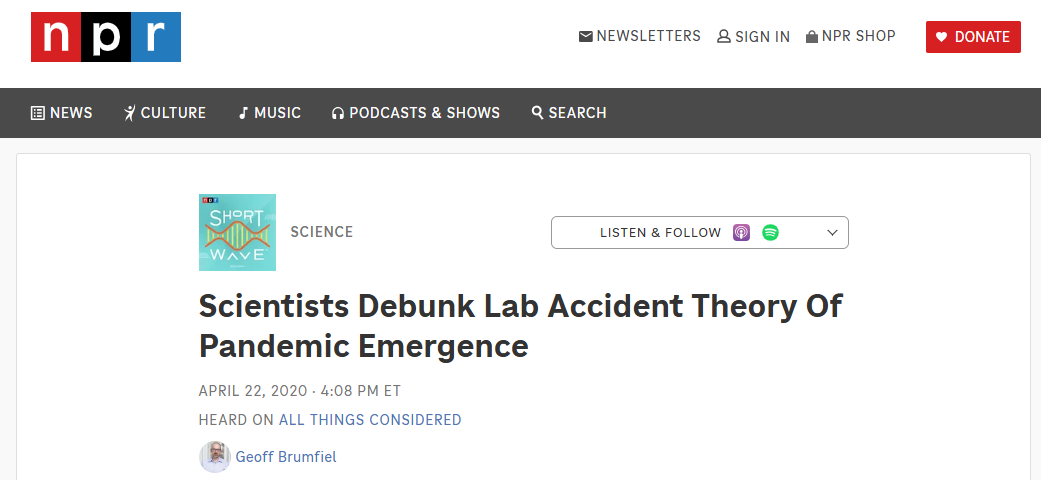
During the COVID-19 pandemic, NPR dismissed the lab leak theory, stating that scientists had “debunked” the idea that the virus originated in a Wuhan, China lab.
In March 2020, the network also halted coverage of President Trump’s coronavirus task force briefings in the Seattle area, a move that drew criticism from listeners in the region.
NPR has also drawn attention for unusual reports suggesting that topics like country music and birds are “racist,” and has continued to promote narratives alleging that Trump’s 2016 campaign colluded with Russia.
(2/5) NPR reported that country music and birds are racist, told American people to stop eating beef, and promoted the Russia-gate conspiracy.
No person with a brain above a single-celled organism would call these articles fair and balanced. pic.twitter.com/vpCl2Y74TI — John Kennedy (@SenJohnKennedy) July 16, 2025
The network has also published pieces questioning whether men have any biological advantage over women in sports—claims that Republican Sen. John Kennedy of Louisiana criticized in remarks on the Senate floor.
(4/5) NPR reported that there is no evidence that biological men have an unfair advantage over biological women in sports. NPR also called America’s interstate highways racist. I did not know our highways were racist. I thought they were concrete, but not according to NPR. pic.twitter.com/O1vCqlc4JY
— John Kennedy (@SenJohnKennedy) July 16, 2025
In April 2024, longtime NPR editor Uri Berliner wrote in The Free Press that NPR had strayed from its journalistic mission by pushing the Russia collusion narrative and prioritizing identity-based reporting.
Berliner stated that the network lacked “viewpoint diversity” and had internal agreement about editorial direction, especially regarding race and politics.
Asked Thursday about Maher’s claim that cuts to NPR funding could pose a “risk” to public safety, White House Press Secretary Karoline Leavitt responded by calling NPR and PBS “propaganda voices” for the political left.
🚨 The CEO of NPR is claiming that the cuts to their network could be "a real risk to the public safety of the country."@reaganreese_: "Can you respond to these concerns?"
LEAVITT: "These [NPR & PBS] are not honest news organizations. These are partisan, left-wing outlets that… pic.twitter.com/mixsRRoq6S — Daily Caller (@DailyCaller) July 17, 2025
The Trump administration’s rescissions package, approved by the Senate, effectively ends federal funding streams that have supported public broadcasting for decades.
Additional cuts in the package also target overseas aid and non-military discretionary spending that the White House described as “wasteful” or “duplicative.”
Gold is the oldest answer. SoundMoney makes owning it as easy as the apps you already use.
Join the Discussion
COMMENTS POLICY: We have no tolerance for messages of violence, racism, vulgarity, obscenity or other such discourteous behavior. Thank you for contributing to a respectful and useful online dialogue.
What is wrong with Amerikans hearing two sides of a story ?
Are you suggesting that the government itself is telling the truth;
when nobody in the US trust their government .
Come on don’t make us laugh about your naivety.
NPR/PBS can tell any story they want but the public should not have to pay them to do it.
When did they ever tell two sides? Before jumping on a band wagon, make sure it isn’t headed off a cliff.
Somebody who spells Americans with a K had nothing to lecture us about.
We’re $37 Trillion in debt ‼️We didn’t get there overnight! It’s going to be painful, but we need to cut spending on everything‼️
2 sides if any story are fine, as long as both are factual. Lies are lies…don’t be naive.
NPR and PBS have finally received their just reward.
The lefts control of the Media in USA is quickly dying – Thank God and President Trump
Sometimes I wonder if people like the CEO of NPR Katherine Maher are so far left that they actually think what is being broadcasted on NPR is unbiased, or are they so partisan that they push their far left agenda and try to pass it off as being unbiased?