WHAT YOU NEED TO KNOW
- Sailors described weeks or months of waiting for mental health appointments during prolonged carrier deployments.
- After one counselor left the USS Abraham Lincoln, 5,000 service members reportedly had two licensed mental health clinicians.
- Some shipboard mental health professionals increased their weekly workload from 40 hours to 90 hours.
- The Navy employs 34 deployed resiliency counselors, filling 81% of authorized capacity.
The Navy system intended to support sailors’ mental health aboard deployed aircraft carriers cannot meet demand during prolonged combat operations, according to current and former military personnel who described long waits, overwhelming caseloads and treatment poorly suited to conditions at sea.
Sailors and Navy mental health professionals said that some service members wait weeks or even months to see a provider.
Therapists, meanwhile, confront administrative burdens and more patients than they can effectively treat.
“The practice does not really match the [needs] of the ship that needs quick response, quick triage and longer sessions,” said one Navy mental health professional who served aboard an aircraft carrier during an extended deployment.
Gold. Upgraded. Buy real gold from $1. Store it in America. Sell it with one click.
Several people spoke anonymously because they feared military reprisal.
One mental health professional said appointment delays conflict with an environment where providers must manage crises quickly.
The problem is compounded by the limited number of mental health personnel assigned to assist thousands of sailors aboard a ship.
Sources said that imbalance contributes to longer waits, therapist burnout and less effective care.
This Could Be the Most Important Video Gun Owners Watch All Year
Concerns intensified during the USS Abraham Lincoln’s extended deployment.
Military Times reported in August that two sailors had attempted to jump overboard as the deployment stretched into its ninth month.
During an August town hall in San Diego, California, military family members raised concerns about food shortages, declining morale and the crew’s mental health.
The Navy said the Lincoln had five chaplains, one clinical psychologist, one clinical social worker, three behavioral health technicians and an embedded integrated prevention coordination counselor.
The Navy reportedly told families that more mental health professionals were being sent to the carrier.

However, a Lincoln sailor said an onboard deployed resiliency counselor left six months into the deployment for personal reasons and had not been replaced by a Sept. 2 port call in Thailand.
Deployed resiliency counselors are licensed civilian mental health clinicians placed aboard ships to provide additional resources.
After the Lincoln counselor departed, 5,000 service members were left with two licensed mental health clinicians, according to the source account.
The Navy maintained that the ratio matched its evaluation of sailor needs, which was based on deployments observed over two decades.
Cmdr. Katie Pierce, a Navy operational psychologist serving on the Navy’s suicide prevention team, addressed the staffing calculation during a media roundtable in Washington.
“Approximately 1,600 to 2,500 personnel — one mental health person can handle,” Pierce said.
MORE NEWS: Country With Policies the Democrat Socialists Want to Implement Just Plunged Into Darkness
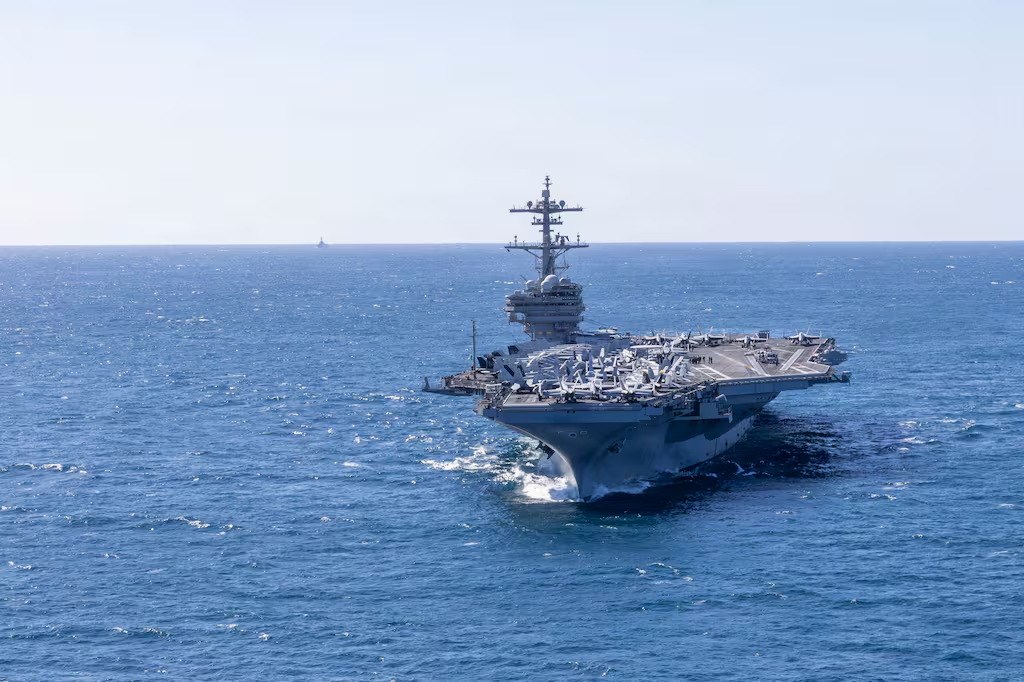
Sources said that shipboard psychologists and counselors still routinely exceeded capacity, with some increasing their work weeks from 40 hours to 90.
Sailors who served aboard the Lincoln and USS Harry S. Truman during extended deployments described severe appointment bottlenecks.
“Unless you say you’re suicidal, you have to wait weeks for an appointment with the military mental health providers,” the Lincoln sailor said.
“The healthcare and mental healthcare of the Navy is abysmal,” said a Truman sailor who deployed during the carrier’s 2024 operations in the Red Sea.
The Truman’s eight month deployment was extended twice during combat operations against the Iran backed Houthi rebels.
“There is not enough staff for the 3,000 to 5,000 personnel on board,” the Truman sailor said.

“It may take months to get an appointment, and when you are seen, you have, at maximum, two issues you can speak to your provider for.”
Sam Rodriguez, a former sailor who worked ashore in the medical evacuation unit at Naval Medical Center Portsmouth, Virginia, said most personnel passing through that unit did so for mental health reasons. He said sailors sometimes waited 54 days for an initial appointment ashore.
“The mission of mental health in the military is really like, ‘How can we get you back to the mission?’” Rodriguez said. “Not ‘How can we take care of you?’”
Providers aboard carriers also have distinct responsibilities. Clinical social workers may provide ongoing care without clinical assessments, psychologists assist sailors experiencing suicidal ideation or requiring psychiatric help, and deployed resiliency counselors provide clinical therapy but do not handle suicidal ideation.
The Navy employs 34 deployed resiliency counselors, representing 81% of the billet’s capacity, according to a service spokesperson.
Other resources include prevention coordinators offering classes, psychology technicians assisting with triage and chaplains providing basic counseling.
Paperwork creates another obstacle. Counselors are expected to upload patient notes into the Fleet and Family Support Management Information System, but unreliable internet connectivity at sea can leave months of backlogged documentation when they return ashore.

Commander, Naval Installations Command, was evaluating ways to make that process more efficient, a Navy spokesperson said.
Still, two Navy mental health professionals said the carrier system positions neither providers nor sailors for success during extended combat deployments.
Civilian counselors generally train around a 40 hour week, but that schedule becomes nearly impossible aboard a carrier with thousands of sailors.
“The volume on an aircraft carrier is so much greater, and the need is so much greater,” one Navy mental health professional said.
The professional said the current model was inadequate for thousands of service members.
A former civilian Navy psychologist added that primary care style treatment might address sleep and negative thoughts without examining deeper problems, saying, “It’s not going to be adequate for people who are struggling with more severe depression or trauma.”
Gold is the oldest answer. SoundMoney makes owning it as easy as the apps you already use.
The opinions expressed by contributors and/or content partners are their own and do not necessarily reflect the views of LifeZette. Contact us for guidelines on submitting your own commentary.
Join the Discussion
COMMENTS POLICY: We have no tolerance for messages of violence, racism, vulgarity, obscenity or other such discourteous behavior. Thank you for contributing to a respectful and useful online dialogue.