WHAT YOU NEED TO KNOW
- Army researchers tested adaptive camouflage concepts in Pituffik, Greenland, as part of a multinational Arctic research effort.
- Novel coatings were measured with sensors to determine how effectively they concealed equipment across visible and other wavelengths.
- Researchers drew inspiration from Arctic foxes, which change from white in winter to brown in summer.
- A rapidly deployable coating system is planned for testing on Army Cold Weather All-Terrain Vehicles in Alaska.
Army researchers are testing camouflage concepts designed to help boats, vehicles and weapons blend into landscapes that can shift with terrain, light and the seasons. The technology could eventually use outer shells, coatings or coverings that change as conditions change, adding another layer of concealment.
The concept was a major focus of an Army Corps of Engineers and Army Research Laboratory experiment conducted in Pituffik, Greenland, earlier this year. The experiment belonged to a broader testing series organized by the International Cooperative Engagement Program for Polar Research, known as ICE-PPR, and the Office of Naval Research.
The multinational effort reflects the Arctic’s increasing importance as a warfighting domain. Yet the region also creates distinct camouflage challenges, according to Dr. Tom Douglas, a research chemist and senior scientific technical manager at the Army Corps of Engineers’ Cold Regions Research and Engineering Laboratory Alaska Research Office in Fairbanks, Alaska.
“It’s dark for some periods; it’s light for other periods,” Douglas told Military Times. He also described how changing sunlight, sea ice, exposed snow and the absence of vegetation can leave personnel or equipment glaringly visible.
Camouflage that works under one set of conditions can become less effective when snow or coatings alter its appearance. In the Arctic’s vast open spaces, a bad match can make equipment stand out instead of helping it disappear.
Anthony Fragoso, the cold regions artificial intelligence lead at the Cold Regions Research and Engineering Laboratory, worked with Army Research Laboratory staff during operations between ships and shore. Researchers tested “a number of novel coatings” and used sensors to measure how effectively those coatings concealed equipment.
Fragoso said visual camouflage alone is not enough because adversaries can observe terrain beyond wavelengths visible to the human eye. “If you go beyond the visible, which our adversaries can do, snow in certain wavelengths looks black. But it’s white in visible,” he said.
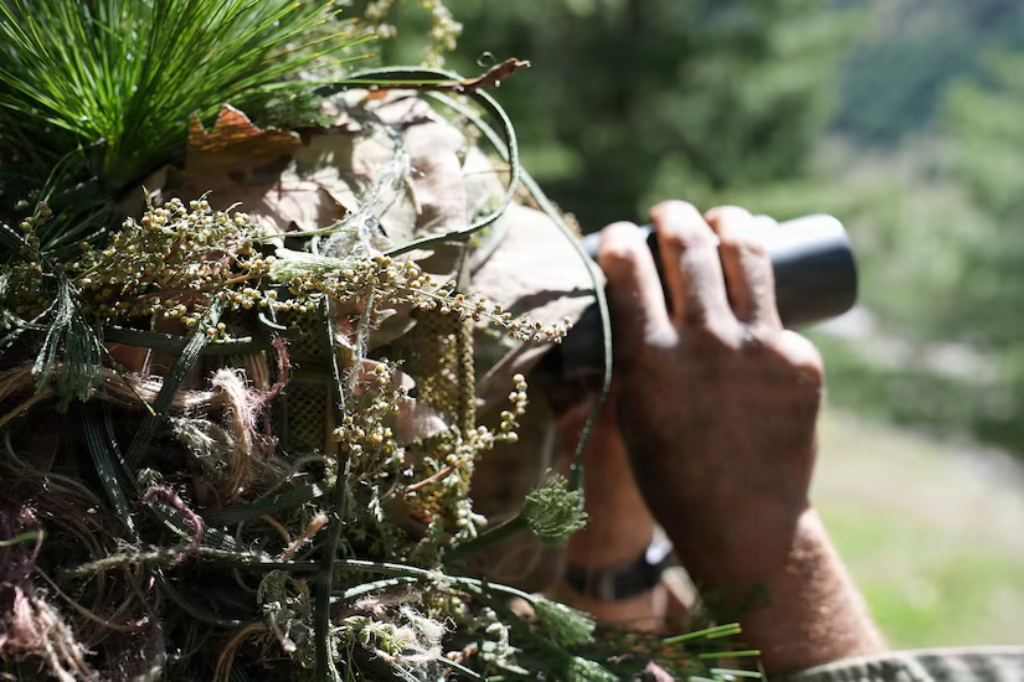
U.S. and Indian Army snipers train together on long-range marksmanship at the sniper firing range near Auli, India, Sept. 22, 2026, during Exercise Yudh Abhyas 2026.
That mismatch presents a serious technical problem for researchers trying to imitate snow across different sensors. A surface that appears properly concealed to a person may look dramatically different when viewed through another wavelength.
Researchers found inspiration in the Arctic foxes around Pituffik, which change from white during winter to brown during summer. “Things that are reversible, flexible is kind of what we’re after,” Fragoso said.
That flexibility matters for units such as the Alaska based 11th Airborne Division, which also deploys regularly to the Pacific. “They’re the Arctic Angels, but they are also worried about fighting in the jungle,” Fragoso said. “So they don’t want to paint stuff white, and then it has to go to Taiwan.”
Although the project remains at the scientific research and development stage, parts of the work are already moving toward operational units. Researchers plan to test a rapidly deployable coating system on the Army’s Cold Weather All-Terrain Vehicles in Alaska.
MORE NEWS: Judge Torches DOJ, Tosses Case Against Ex-FBI Officials Accused of Lying About Hunter Biden Probe
“The Alaska National Guard is going to fly over it with helicopters, film it with thermal, all that stuff,” Fragoso said. “Everything now is counter-[unmanned aerial systems], so it’s making sure stuff isn’t being spotted from above by a $1,000 drone.”
Mike Parker, the cold regions mobility lead for the Cold Regions Research and Engineering Laboratory, said the search for flexible camouflage is not confined to Arctic operations. Modern overhead surveillance has created demand for concealment that can be altered quickly to match new operating environments.
“It has to remain flexible, and all aspects of it are on the table,” Parker said. “It doesn’t have to be just a coating; it could be a fabric … anything that can give us the tactical advantage is being evaluated.”
The testing therefore includes coatings, fabrics and other adaptable options rather than one permanent solution. Researchers are seeking concealment that can respond to changing seasons, terrain and surveillance methods while remaining useful for units that may move from Arctic snow to Pacific jungle conditions.
The opinions expressed by contributors and/or content partners are their own and do not necessarily reflect the views of LifeZette. Contact us for guidelines on submitting your own commentary.
Join the Discussion
COMMENTS POLICY: We have no tolerance for messages of violence, racism, vulgarity, obscenity or other such discourteous behavior. Thank you for contributing to a respectful and useful online dialogue.