Mark Cuban delivered a blunt business lesson to Rep. Ro Khanna after the California Democrat defended a proposed 5% wealth tax on billionaires.
Cuban warned that the measure could chase entrepreneurs, investors, and valuable companies straight out of the state.
The clash centered on California Proposition 40, a ballot measure that would impose a one-time tax on residents holding more than $1 billion in assets.
The California Democratic Party has endorsed the proposal, although Gov. Gavin Newsom has expressed opposition.
Gold. Upgraded. Buy real gold from $1. Store it in America. Sell it with one click.
Khanna argued in a video posted to X that the tax would preserve health care services for working-class Californians.
He also accused the Sacramento political establishment and lobbyists fighting the measure of being out of touch with ordinary voters.
WATCH:
This Could Be the Most Important Video Gun Owners Watch All Year
Cuban responded by pointing to a basic financial reality that tax-hungry politicians often ignore.
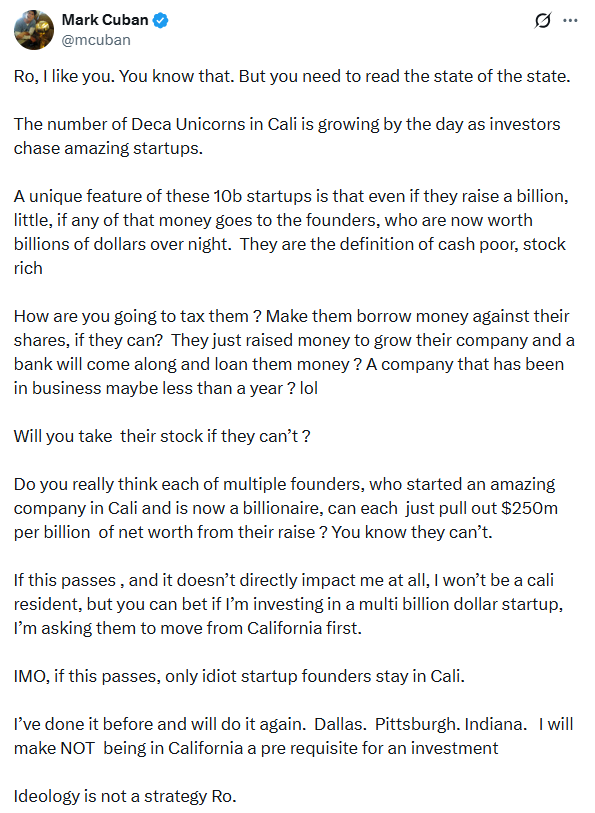
Startup founders can become billionaires on paper because their company shares rise in value, even though they may have nowhere near enough available cash to cover a massive tax bill.
“They are the definition of cash poor, stock rich,” Cuban wrote on X.
His point was simple: A valuable ownership stake is not the same thing as hundreds of millions of dollars sitting in a checking account.
Cuban warned that the proposal would give founders and investors a powerful reason to abandon California before the tax collector arrives.
“If this passes, only idiot startup founders stay in Cali,” he wrote.
The billionaire investor also made clear that the measure could change his own investment decisions.
“I will make NOT being in California a pre requisite for an investment,” Cuban continued, raising the prospect that promising California businesses could lose access to his capital.
Khanna attempted to answer the liquidity problem by proposing government loans for founders whose fortunes are trapped in private company shares.
“Why not a non recourse loan for pledged stock as collateral for this situation?” Khanna wrote.
Under Khanna’s idea, founders could pledge company shares to California as collateral, receive a government loan, and then use that money to pay the state tax.
The loan could remain outstanding for about 10 years before being repaid with cash or surrendered shares.
Why not a non recourse loan for pledged stock as collateral for this situation?
— Ro Khanna (@RoKhanna) August 15, 2026
Cuban quickly identified the circular logic.
California would lend money to a founder, who would immediately return that same money to California as a tax payment, producing no new cash from that taxpayer when the transaction occurred.
The arrangement could also leave California holding ownership stakes in private companies if founders could not repay their loans.
Cuban mocked the possibility of government becoming an involuntary venture capital operation, writing, “Cali, You make it. We take it!”
Khanna insisted that the state would still receive money from wealthy residents with liquid holdings.
“The government would still collect from the vast majority of billionaires who are not illiquid,” he wrote, claiming that 72% of billionaire wealth is held in publicly traded stock.
Khanna then appealed to public resentment of wealthy Americans rather than Cuban’s concerns about investment and company formation.
“Mark, come on a road trip with me around California, Pennsylvania and the country and ask ordinary Americans how they feel about a billionaire tax,” Khanna wrote.
“Most say, I promise you, why only 5 percent?”
Cuban answered with the sort of directness rarely heard in Washington. “You don't understand business Ro.”
He explained that a successful founder could spend a decade building a company, employing thousands of people, and paying enormous federal and state tax bills without ever holding $250 million in liquid assets.
Forcing that founder to sell shares could weaken control of the company and punish years of reinvestment.
“Is that what you want your state to be?” Cuban asked.
Khanna continued arguing that most of California’s roughly 250 billionaires would not face the liquidity challenge Cuban described.
Cuban’s sharpest criticism focused on what the tax would signal to entrepreneurs who pour their resources back into growing businesses.
Rather than rewarding job creation and risk, California Democrats would treat rising company value as an invitation for government confiscation.
The dispute exposes the central flaw in wealth taxes.
Politicians see a large valuation and imagine a pile of cash ready for Sacramento, while business owners see ownership, payroll, expansion, research, and years of risk.
California already struggles with residents and companies seeking friendlier tax climates elsewhere.
If Proposition 40 passes, Cuban’s warning suggests the state could accelerate that exodus and discover that successful people are perfectly capable of moving before Sacramento sends the bill.
Gold is the oldest answer. SoundMoney makes owning it as easy as the apps you already use.
Join the Discussion
COMMENTS POLICY: We have no tolerance for messages of violence, racism, vulgarity, obscenity or other such discourteous behavior. Thank you for contributing to a respectful and useful online dialogue.
In the meantime, Florida and Texas are ready to welcome Mr. Cuban and the others, willing to walk away from this unconstitutional theft, with open arms. What we likely need is a Constitutional amendment that establishes a single tax rate for all individuals at both the state and federal levels, and a requirement that NO governmental unit is permitted to spend in excess of actual revenues. In view of the massive nationwide fraudulent uses of tax dollars, this is a no brainer! Taxpayers in the U.S.A. have been abused enough for 80 lifetimes, so give us a break and stop the steal, regardless of your ideology!
I agree with MOST of your comment. IMHO and with respect to your post…
The Texas and Florida part gets the Thumbs Up.
Single Tax Rate part NFW. That’s been talked about for the past 40 and NOTHING’S HAPPENED. It won’t happen and never will.Poor people can’t afford a 10% income tax when they pay NO TAX at all and $$$$$$$$aires would wet their pants to pay only 10%.
Massive Nationwide Fraudulent Uses of Tax Dollars won’t go away. demos prickzer, walz, omar, and noose’EM have too much $kin the fraud game. Reducing/eliminating the federal fraud gravy train means losing the leeching votes they count on.
The Requirement That NO Governmental Unit Is Permitted To $pend In Exce$$ Of Actual Revenues is an outright invitation for demo states to raise taxes. You can be assured $pending won’t be cut as the system-leeching voters would leave those demos like rats in a sinking ship.
I’m not being critical, just realistic.
Blah, blah, blah! Mark Cuban is a liberal who always votes for the crap he complains about. Example: He blathered on and on about what a hero Anthony Fauci was for years. Now he’s shocked that Fauci was a fraud.
In other words A-HOLES, COMMUNISM, the state owns everything, fools! A vote for any (D)emon is a suicidal act – you’ll eventually get your wish, FOOLS and TOOLS of the POLIBURO aka (D)emons!
I wonder how many votes Vlad Putin would get if he ran in November? demos would be standing by copy machines and tombstones to guarantee his win.
Hey, eric stinkwell and adam sniff, don’t bother LYING to us about President Donald Trump being Putin’s Puppet, you demos ARE!